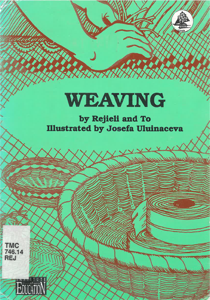
Weaving
by Rejieli & To
Set in Fiji, this is a beautifully crafted story about the Pacific tradition of weaving. Using simple, repetitive language, the story describes how each person weaves for a specific purpose – whether it be a bag, a hat, a mat, a basket. The story presents an interesting slant on the idea of “weaving”, when it tells how “Grandma is weaving a long, long story”, thus highlighting the value placed on oral traditions in Pacific Island cultures as well. The black and white illustrations are detailed and emotive, and draw the reader into the images of the Pacific.
This book was nominated for the collection because it shows Pacific Island tradition and art, and could be used very effectively by teachers in classrooms, to teach weaving as an art/ technology topic.
Please note that these activities are suggestions which have not yet been trialled. We welcome any feedback on how they play out in the classroom (see the feedback section).
|
Activity: WEAVING (The Arts/ Technology) |
|
| Curriculum Level | 1, 2 & 3 (see curriculum links at the end of the activity) |
|
NZC Key Competencies |
|
|
Description |
In this book we see the many different uses for flax weaving, as well as the value of these flax-woven every-day items in the daily lives of the Fijian people.In this activity children learn how to weave using firstly paper strips, and then they may even have a go with flax.
1. Read the story with students and identify all the useful things which can be made with flax: bangles, hats, baskets, fans, thick cords, fishing traps and nets, roof thatching, mats, wristlets and skirts (clothing).If possible, have some of these items available for children to look at and hold. 2. Have a go at practising the skills of weaving: give children 2 different coloured strips of paper. One colour may not be cut all the way, so that this provides a “base” for weaving in the other colours. 3. Demonstrate how to weave in and out of the “base” strips. Repeat with each strip, alternating the “over and under” pattern each time. 4. When all of the strips have been woven in, they can be stapled into place. The children will have each made a small, colourful mat, which could be used as a place mat at their tables or displayed on the wall. You could then go on to have a go using real flax.
Ask: why might people choose to use flax rather than paper to make items like roofing and baskets?
Children could repeat the activity using flax instead of paper. At Levels 2 and 3, they may then go on to have a go at weaving an item, such as a basket or kete – see “taking it further” for ideas on this. |
|
Materials |
http://www.alibrown.co.nz/gathering-flax.html |
|
Taking it further |
Once children have mastered the skill of weaving, they could learn how to make bags, bangles, skirts etc…. Use ideas from the story to decide what they are going to make. This will bring in the technology aspect of the activity – making something for a particular purpose. See these websites for “how to” instructions on weaving useful items:
|
| Curriculum Links | Visual Art
Technology Technological Practice Planning for practice:
Brief development:
Outcome development and evaluation:
|
|
Links to other books in the PPBC and NZPBC |
The Woven Flax Kete by Angie Belcher– a boy uses an old flax kete of his grandmother’s to collect “treasures” in.The Kuia and the Spider by Patricia Grace– this book is part of the New Zealand Picture Book Collection, and is about a Kuia and a Spider who compete over whose weaving is the best. |
|
Other ideas |
Older children could focus in on the last page, where “Grandma is weaving a long, long story.” Talk about the oral traditions of the Pacific Islands and the importance of handing stories down through generations, through the art of storytelling. This was especially important before reading and writing was introduced, as it was the only way of sharing stories (English/ Social Sciences) |


