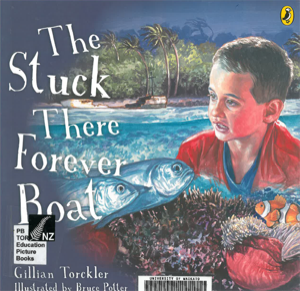
The Stuck There Forever Boat
by Gillian Torckler
This story was inspired by the Tuvaluan people, whose low-lying island nation is under threat due to the rising sea levels associated with global warming. This story highlights the human dimension of the effects of global warming on families, as we read of Tama and his Nanny coming to grips with the sad possibility of having to leave their cherished island to find a new home elsewhere.
The book has been beautifully illustrated in watercolours by Bruce Potter.
This book was nominated for its beautiful illustrations, as well as being “ … a nicely told story …of rising sea levels and global warming. And… it shows in a very simple way some of the passion, feeling for their lands …” (Rob).
Please note that these activities are suggestions which have not yet been trialled. We welcome any feedback on how they play out in the classroom (see the feedback section).
|
Activity: THE EFFECTS OF CLIMATE CHANGE (Science/ Social Sciences) |
|
|
Curriculum Level |
2 & 3 (see curriculum links at the end of the activity) |
|
NZC Key Competencies |
|
|
Description |
In the back of this book, there is an explanation about how rising sea levels are a very real threat for some Pacific Islands, especially the island of Tuvalu, on which this story is based. This story could be the starting point for some research into global warming at its effects, and what can be done to help slow down its progress.
1. Before reading the story, ask the students:
Discuss in groups and then as a class, sharing ideas. 2. Explain that you are going to read a story now which will give us an example of how global warming is affecting people in the Pacific Islands, because of rising sea levels. Tell them that at the end of reading, you want them to be able to name some of the signs of rising sea levels. 3. Read together. 4. After reading, talk with a partner to identify signs there were in the story that indicated rising sea levels.
5. Share back as a class, and list signs on the board. Ask students: how is this affecting daily life for the people who live on this Pacfic Island? They are running out of food to eat – fish as well as vegetables. Sea life is dying. Soon their houses will be under water. 6. Establish that rising sea levels (and global warming in general) is a very real thing for many cultures around the world. So what can we do to help? Share initial thoughts and ideas as a class. You may like to record these up on the board, to refer back to later, as well as providing a starting point for students’ own research. 7. Organise students into 5 groups. Each group should go away and explore one of the following resources. They want to find out WHAT we can do to help slow down global warming:
8. Share back findings with the class. Look again at initial list on the board, identifying ways that we might be able to slow down global warming. Add or delete suggestions as necessary. 9. Students could then choose one to design a poster about. Display posters around school to educate others about the effects of global warming, and what can be done to help. |
|
Materials |
|
|
Curriculum Links |
SciencePlanet Earth and Beyond
Living World
Social Sciences
|
|
Links to other PPBC books |
Pou and Miri Tackle Climate Change by Dom Sansom– this book also deals with climate change global warming |
|
Other Ideas |
|


