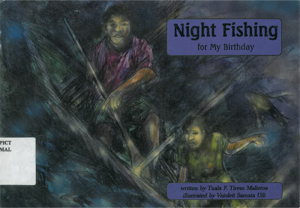
Night Fishing for my Birthday
by Tuala F. Tiresa Malietoa
Everyone is a little worried when Sifa asks if he can go night fishing for flying fish, to celebrate his birthday. His Uncle Seti had previously lost an arm when he was bitten by a shark while night fishing once. Despite this, he is allowed to go, and learns what it means to be a true hero when the canoe turns and he is tipped out of the boat. This story shows a unique aspect of Pacific Island culture, and has been illustrated beautifully using pencil and water colours, by Vaioleti Samata Uili.
This book was nominated for the collection because it shows life in the Pacific Islands.
Please note that these activities are suggestions which have not yet been trialled. We welcome any feedback on how they play out in the classroom (see the feedback section).
|
Activity: LANGUAGES OF THE PACIFIC (Learning Languages) |
||
| Curriculum Level | 1 & 2(see curriculum links at the end of the activity) | |
|
NZC Key Competencies |
|
|
|
Description |
This book is available in Samoan and English versions, so provides an excellent resource for use in supporting the learning of a new language. It could also be used very effectively with bilingual learners.1. Invite older children or adults from the community, who are able to read and speak in Samoan. You may even have students in the class who are able to read and speak Samoan – and are willing to do so in front of the class (they may not be!). Ask them to come and read the story – first in English, and then in Samoan.Talk about the ideas presented in it. Encourage them to talk about what is happening in the illustrations as they read the Samoan language version, so that children are aware of what is happening in the story, while they are listening to a new language being spoken.
2. Make links to children’s own experiences of fishing – some of them may even have been night fishing themselves. Talk about why it is a potentially dangerous thing to do. Talk about how brave Uncle Seti must have been when he was attacked by a shark! 3. Pick out some key Samoan words from the story to teach children. Children can make cards with both Samoan and English vocabulary on them, as well as a picture. Use the cards to play memory or snap with a partner. The following translations might be useful:
4. Ask the visitor to choose a short passage from the story. Have the words of this passage so that they are visible to all students, and have them learn how to read this passage, using correct pronunciation. Children could go away and practice with a buddy, then “perform” the passage to the class and visitor. |
|
| Curriculum Links | Learning LanguagesProficiency Descriptor
Communication Selecting and using language, symbols and texts to communicate
Participating and contributing in communities
Language Knowledge
Cultural Knowledge
|
|
|
Links to other books in the PPBC |
Watercress Tuna and the Children of Champion Street by Patricia GraceKa’akapera Tikai by Lino Nelisi
Tane Steals the Show by Lino Nelisi Sione’s Talo by Lino Nelisi My School Bag, My Preschool, When I go to church by Tolo Pereira Upside-down Face by Lemalu Ros Afamasaga The Woven Flax Kete by Angie Belcher O Le Aso S Pa’eoa’e by Saron Aiono-Iosefa O Le Fa’aipoipoga by Emma Kruse Vaai – all of these books are available in dual or multi language versions, to support bilingual and new language learners. |
|
|
Other ideas |
|
|


